Chandrayaan-4 changed its rocket mid-development. Here is what that means for the sample return
Five modules, two launches and a launch vehicle that has to be rebuilt before it can fly. The mission is still officially on track for October 2027.
By Gaurav Menon · Science Correspondent, Science

The short version
- Chandrayaan-4's five spacecraft modules weigh about 9,200 kg together, more than a single LVM3 can lift, so the mission is split across two launches that dock in Earth orbit.
- A Rajya Sabha standing committee report tabled in March 2026 recorded that raw materials for the launch vehicle were deferred because ISRO changed the rocket to incorporate a semi-cryogenic engine.
- The first fully integrated hot test of that engine is targeted for the end of 2026, and the upgraded vehicle is expected only in 2028-29 on the official calendar, against a mission date of October 2027.
India's first attempt at bringing lunar soil home is not going the way it was designed to go, and the change is in the rocket rather than the spacecraft. Chandrayaan-4, targeted for October 2027, will have to wait on a launch vehicle that ISRO has decided to rebuild in the middle of development.
Why two rockets in the first place
The mission has five modules — a Descender and an Ascender that go down to the surface and back, and a Propulsion, Transfer and Re-entry unit that stays in lunar orbit for the return leg. Together they weigh roughly 9,200 kg. LVM3, India's heaviest operational launcher, can put about 8,000 kg into low Earth orbit. One rocket therefore cannot do it, so the modules fly separately and rendezvous in Earth orbit before the integrated spacecraft leaves for the Moon.
That two-launch architecture was always the plan, and it is genuinely unprecedented — no country has returned samples from the lunar south pole. The sequence is that the first LVM3 carries the landing stack to Earth orbit, and a second, shortly afterwards, carries the propulsion, transfer and re-entry units up to dock with it.
The reason for the switch is a semi-cryogenic engine, which burns liquefied gas as an oxidiser with a liquid hydrocarbon fuel. India has cryogenic engine experience — the CE-20 that powers LVM3's upper stage is one — but a semi-cryogenic core stage is a different proposition, and the first fully integrated hot test is still ahead.
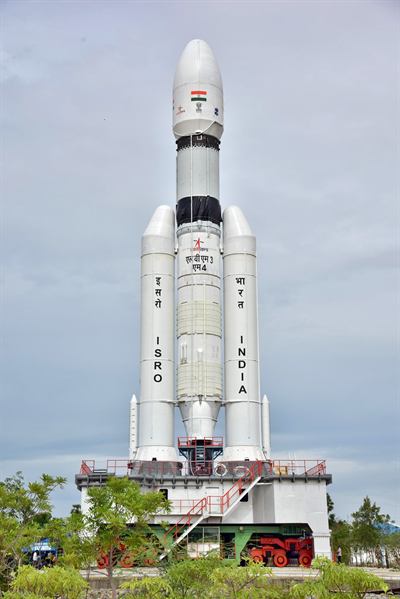
For context on what is being asked of the launcher: LVM3 stands 43.5 metres tall with a gross lift-off weight of about 640 tonnes, using two S200 solid boosters, a liquid L110 core stage and a C25 cryogenic upper stage, and is rated for 4,000 kg to geostationary transfer orbit. Its track record is unblemished. What it has not yet done is fly with the engine Chandrayaan-4 now requires.
Sources — 2 references
These are the published sources this article was established against. NOT SCRIPTED wrote the text above; the sources below are credited to their own publishers.
About the byline
Gaurav Menon
Space, physics and the institutions behind them.
Read about the NOT SCRIPTED newsroom and how our bylines work.
Related coverage
ISRO fires the CE-20 at sea level, the long wait for LVM3 steps closer
IN-SPACe's chairman says ISRO will stop making launch vehicles and hand the technology over

PSLV-C62 flew perfectly for eight minutes and then stopped following its path