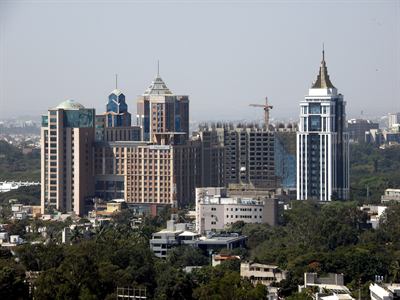
TCS opens an NVIDIA-backed industrial AI lab on its Bengaluru campus
The facility on Global Axis is pitched as a place where enterprises move agentic AI pilots into production for mobility and manufacturing, rather than a research centre.
By Farah Qureshi · Technology Reporter, Technology

The short version
- TCS launched the TCS Autonomous Engineering Lab, powered by NVIDIA, on its Global Axis campus in Bengaluru on July 15, 2026.
- The lab is intended to help enterprises move industrial AI from pilots to production-scale deployment.
- The stated focus is mobility and manufacturing, using NVIDIA AI infrastructure for prototyping and simulation.
Tata Consultancy Services opened a lab in Bengaluru on Wednesday that it describes as a physical AI hub for industrial use. The TCS Autonomous Engineering Lab, powered by NVIDIA, sits on the company's Global Axis campus and is aimed at mobility and manufacturing deployments rather than consumer or model research.
The framing is worth noting because it is not the usual one. Announcements of this kind are usually about a partnership, a certification or a training programme. This one is about floor space with hardware in it, and about a specific bottleneck the company has decided to sell against: the gap between a working pilot and something running in a factory or on a vehicle.
- What opened: TCS Autonomous Engineering Lab, powered by NVIDIA, at the Global Axis campus in Bengaluru, on July 15, 2026.
- What it is for: designing, testing and validating industrial AI solutions and taking them to production scale.
- Where it is aimed: mobility, manufacturing and industrial operations.
Pilots versus production
According to the company's communique, the lab is intended to let customers use the TCS and NVIDIA ecosystem to prototype and simulate use cases across industries before deploying them in real-world operations. That is a specific claim about the failure rate of pilots, which is high and well known in enterprise technology, and about the expensive part of any AI project: everything that happens after the demonstration.
The timing is legible too. Indian IT services firms are being asked by their largest clients to demonstrate that agentic AI work has moved from announcements into contracts, and Bengaluru's Global Axis campus already hosts the physical infrastructure for that demonstration. Putting the hardware on site converts an argument about capability into something a client can walk through.
The counterweight is that industrial AI deployments fail for reasons that have nothing to do with simulation fidelity. Data quality inside a plant, integration with legacy control systems, uptime requirements measured in minutes rather than hours — none of those are solved by access to more compute. The lab reduces one category of risk and leaves the others untouched.
Sources — 2 references
These are the published sources this article was established against. NOT SCRIPTED wrote the text above; the sources below are credited to their own publishers.
About the byline
Farah Qureshi
Startups, platforms and the labour behind the product.
Read about the NOT SCRIPTED newsroom and how our bylines work.
Related coverage
Bengaluru's Green Line runs in a short loop for 45 minutes after a power breakdown
BJP asks the Governor to probe the Bengaluru solid-waste tender awarded for 30 years

Bengaluru's ward elections get a date: deadline extended to August 31