A more precise measurement of primordial helium tightens the test of Big Bang physics
The LBT Yp Project's determination of the primordial helium-4 mass fraction, Yp = 0.2458 ± 0.0013, is the most precise to date. Combined with primordial deuterium, it constrains the number of light neutrino families and confirms standard Big Bang nucleosynthesis at a level that can probe physics beyond the Standard Model.
By NOT SCRIPTED Desk · Reference Desk, Archive
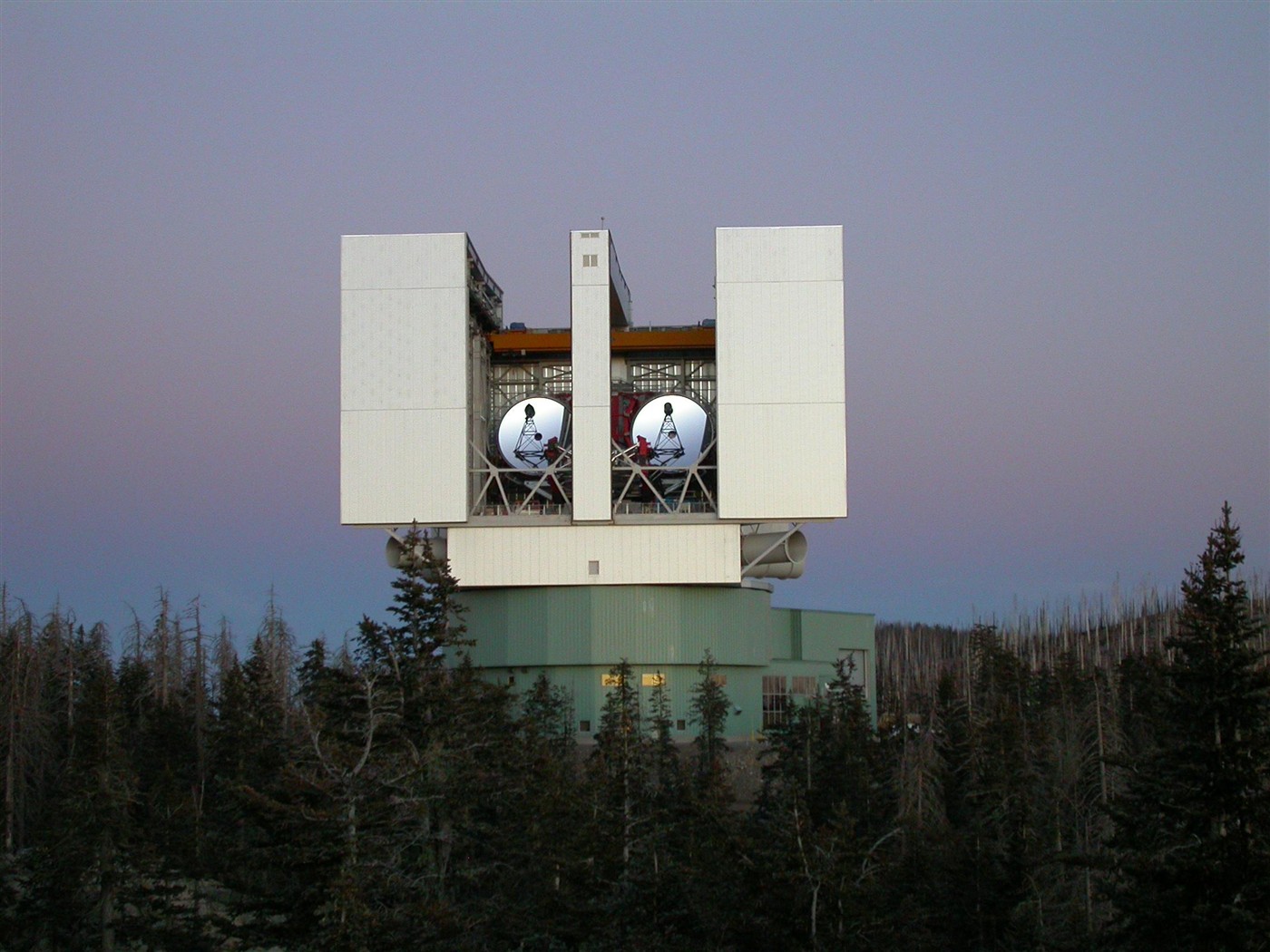
The short version
- The LBT Yp Project measured the primordial helium-4 mass fraction as Yp = 0.2458 ± 0.0013, the most precise determination to date, using observations of extremely low-metallicity HII regions with the Large Binocular Telescope.
- Yp combined with standard Big Bang nucleosynthesis and the neutron half-life provides a direct measurement of the number of light neutrino families; the precision aims to constrain physics beyond the Standard Model at about the 3% level.
- The methodology combines LBT MODS and LUCI spectra with archival calibration over four years to deliver helium abundances in individual HII regions with uncertainties of roughly 2% or less.
- A related 3He/4He measurement along Milky Way sightlines, published in the Astrophysical Journal, found a primordial isotope ratio consistent with Standard Model Big Bang nucleosynthesis at the cosmic microwave background baryon density.
- Future extremely large telescopes are expected to measure 3He/4He in more metal-poor environments for a model-independent determination of the primordial value.
About five minutes after the Big Bang, the young universe had fused roughly a quarter of its baryonic mass into helium-4. Measuring that primordial fraction precisely — written Yp — is one of the cleanest tests of Big Bang nucleosynthesis, and of whether the particle physics underlying it is complete.
The LBT Yp Project's new measurement, Yp = 0.2458 ± 0.0013, is the most precise determination to date. The result comes from observations of extremely low-metallicity HII regions — star-forming gas clouds whose chemistry still reflects the primordial composition — made with the Large Binocular Telescope's MODS and LUCI instruments.
Why a fraction of a percent matters
Yp, combined with standard Big Bang nucleosynthesis and the half-life of the neutron, provides a direct measurement of the number of light neutrino families. The project was designed to deliver a determination with precision of about 0.5%, enough to constrain the effective number of neutrino families at roughly the 3% level — a threshold at which deviations from the Standard Model of particle physics would begin to show.
The methodology depends as much on calibration as on observation. Archival LBT/MODS spectra of standard stars collected over a four-year period enable the determination of a wavelength-dependent uncertainty in the MODS spectral response, which in turn reduces relative emission-line errors in the science observations.
The isotope ratio, and what comes next
A complementary measurement reported in the Astrophysical Journal, by Ryan Cooke of Durham University with James Johnson of Carnegie Observatories, Pasquier Noterdaeme of the Institut d'Astrophysique de Paris, Max Pettini of Cambridge and colleagues, used the upgraded CRyogenic InfraRed Echelle Spectrograph on the Very Large Telescope to determine the helium isotope ratio 3He/4He along Milky Way sightlines, including a less-than-4% precision measure in the Orion Nebula.
That team inferred a primordial isotope ratio of (3He/4He)_P = (1.15 +0.24 −0.21) × 10⁻⁴, which agrees with Big Bang nucleosynthesis calculations that assume the Standard Model of particle physics in combination with the baryon density inferred from cosmic microwave background temperature fluctuations. They note that forthcoming extremely large telescopes are poised to determine 3He/4He in more metal-poor environments, securing a model-independent determination of the primordial value.
Universe Today, in coverage carried by phys.org, framed the result as further confirmation of the standard picture of the Big Bang rather than a challenge to it — the kind of quiet tightening that makes the next generation of telescopes worth building.
Sources — 4 references
These are the published sources this article was established against. NOT SCRIPTED wrote the text above; the sources below are credited to their own publishers.
- arXiv — The LBT Yp Project V: Cosmological Implications of a New Determination of Primordial 4He (opens in a new tab)
- arXiv — The LBT Yp Project I: An Improved Determination of the Primordial Helium Abundance (opens in a new tab)
- arXiv / Astrophysical Journal — Towards a measurement of the primordial helium isotope ratio (Cooke et al.) (opens in a new tab)By Ryan J. Cooke et al.
- phys.org / Universe Today — Primordial helium further confirms our understanding of the Big Bang (opens in a new tab)By Brian Koberlein
About the byline
NOT SCRIPTED Desk
The reference desk maintains NOT SCRIPTED's archive: it verifies events against primary sources, records the source metadata and marks retrospective coverage clearly.
Read about the NOT SCRIPTED newsroom and how our bylines work.
Related coverage
Light, and the switch that opened a field: Deisseroth, Hegemann and Nagel win the 2026 Nobel Prize in Physiology or Medicine

IN-SPACe's chairman says ISRO will stop making launch vehicles and hand the technology over
Four fossil leaves from Assam push the kevda family's record back 24 million years